Human-Machine Interaction
Studying the bidirectional channel between people and computing systems — from measurement instruments to interfaces that adapt to what they perceive.
For thirteen years I have studied how machines can recognise what people feel and how they think. My work sits at the seam between human-machine interaction, affective computing, cognitive states recognition, and eye-tracking — built and tested on real signals, on real hardware, with real people.

Hugo Mitre-Hernández is a full-time researcher at the Centre for Research in Mathematics (CIMAT), Zacatecas Unit, and a Level II member of Mexico's National System of Researchers.
He holds a Ph.D. (2010) and an M.Sc. (2006) in Computer Science and Technology from the Universidad Carlos III de Madrid, and a B.Eng. in Informatics from the Technological Institute of Culiacán (2003). His doctoral training in Madrid laid the foundations of a career devoted to studying how computational systems can perceive and respond to the internal states of their users.
At CIMAT he has led graduate programmes alongside his research: he was Coordinator of the M.Sc. in Robotics (May 2021 – May 2023) and earlier of the Master in Software Engineering (May 2019 – Oct 2020).
His applied work spans public and private projects in Human-Machine Interaction, software engineering, and eye-tracking — translating laboratory findings into compact, deployable systems that work in the wild: educational video games that adapt to a player's cognitive load, microcontrollers that detect anger in domestic environments, and pupillometric methods that quantify mental effort in real time.
Studying the bidirectional channel between people and computing systems — from measurement instruments to interfaces that adapt to what they perceive.
Recognising and modelling emotion from physiological, facial, vocal, and behavioural cues — and reasoning about what to do once the system knows.
Working memory load, attention, and deceit detection inferred from ocular signals; translating laboratory effects into deployable measurements.
Pupillometry and gaze analysis — in VR driving studies, in educational games, and on consumer webcams — as a window into mental effort.
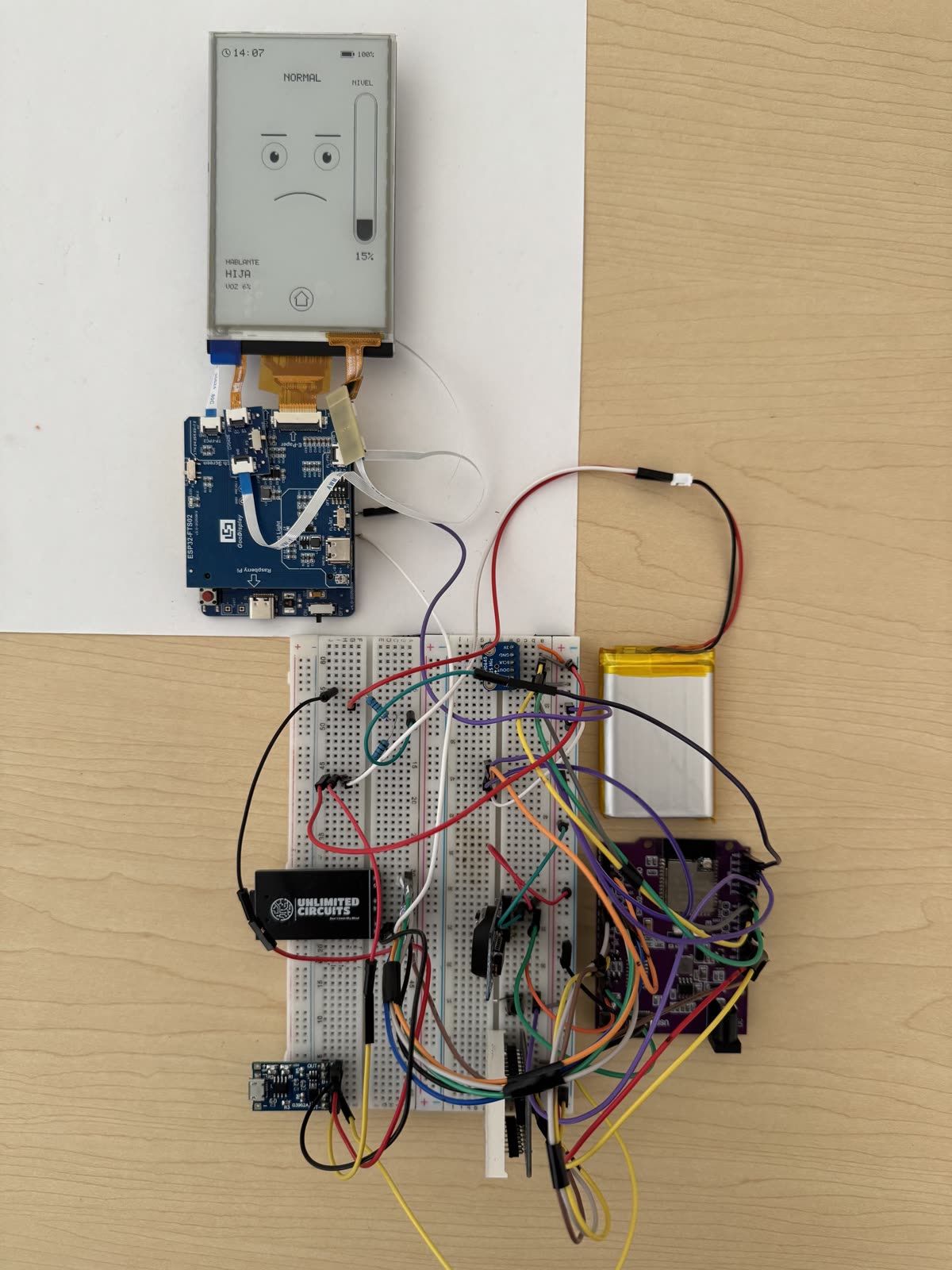
Voice-based emotion recognition has attracted attention for early-warning monitoring in vulnerable households, yet most systems run on phones or PCs — raising cost and stripping speaker identity. We propose a compact hybrid framework that extracts affective and identity-related cues from a single MFCC front-end, deployed on an ESP32-S3 microcontroller for domestic-violence early-warning scenarios.
Two complementary INT8 branches share the same 20×63 MFCC matrix: MicroLightCNN, a LightCNN-derived network for binary anger detection, and MLP-XiEmbedding, an MLP over a deterministic four-statistic Xi-Vector pooling (μ, σ, max, min over 20 Mel bands). Aggregating both cues in one capture window widens perceptual capacity without breaking the memory budget.
On the Emotional Speech Dataset (ESD) and an in-house Mexican-Spanish household corpus, the pair consistently outperforms MCU-deployable variants of DS-CNN, MatchboxNet, ECAPA-TDNN and CAM++ on the joint accuracy–memory–latency frontier. A sliding-window vote of three frames suppresses spurious activations under realistic acoustic variability; the device emits contextual alerts of the form "Dad angry — 63 %" in under 500 ms per 2-second window.
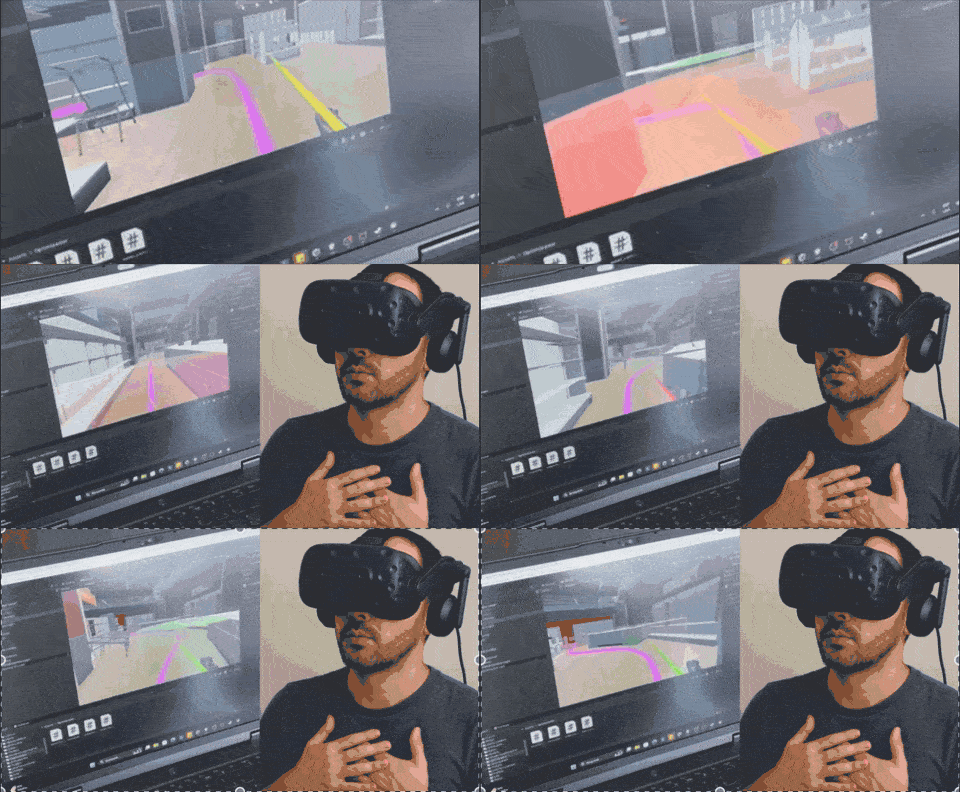
An inclusive artificial-intelligence framework for electric wheelchair control that enables users with severe motor impairments to navigate through eight head-motion commands, including cardinal and diagonal directions. Unlike conventional systems that rely on fixed-threshold detectors and limited command sets, the proposed MSM–LSTM framework models head movements as non-stationary multivariate time series, improving robustness to temporal variability across users.
The system integrates a multi-criteria evaluation protocol for elastic similarity measures, an optimised Proximity Forest 2.0 classifier, and a hybrid MSM–LSTM architecture with confidence-based softmax fusion. Validation was conducted in a Unity-based virtual-reality supermarket using an HTC Vive Pro Eye headset with synchronised data acquisition at 5 Hz.
Results identified MSM, SSDTW, and ERP as the most effective similarity measures, while the proposed classifier achieved perfect F1 scores for cardinal commands and a macro-averaged AUC of 0.91, outperforming a two-layer LSTM baseline. The framework provides a computationally efficient and reproducible solution for accessible head-controlled assistive technologies.
We investigate physiological signals and body movements for real-time detection of anxiety and stress, developing a novel signal-data-selection method tailored to microcontrollers that handle small physiological inputs.
In parallel we design deep-learning models optimised to use computational resources efficiently on the same constrained hardware — keeping inference small, fast, and local.
We study visual distraction during driving inside a virtual-reality environment. The project's centrepiece is a novel model that gauges mental effort by analysing real-time changes in pupil size, enabling us to quantify the challenge posed by distracting driving tasks as they unfold.
Bringing eye-tracking to commodity hardware. We combine computer vision, deep learning, and curated face-eye data collection to develop accurate, low-cost webcam-based eye trackers that bring gaze analytics out of the lab and onto everyday devices.
+ (52) 492 998 0300
CIMAT Zacatecas reception.
CIMAT Zacatecas
Calle Lasec y Andador Galileo Galilei,
Manzana 3, Lote 7, Quantum,
Ciudad del Conocimiento, C.P. 98160,
Zacatecas, Zac., México.