Abstracts of talks
Contents
(In alphabetic order of last name; click an item to show the abstract)
Alejandro Bravo Doddoli, U Michigan, US
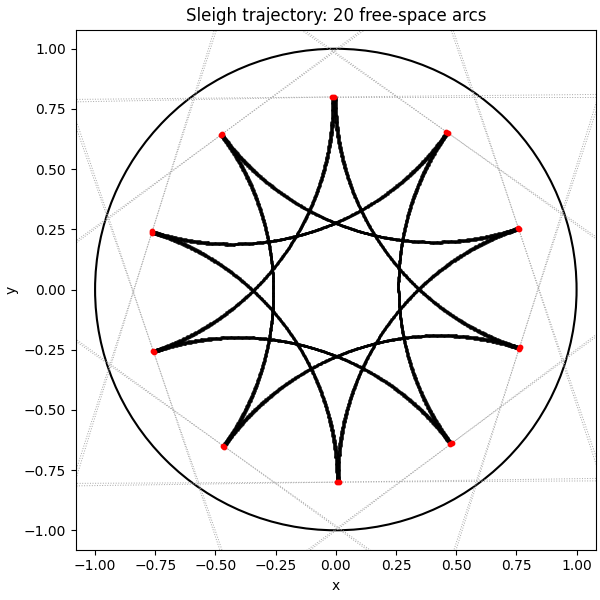
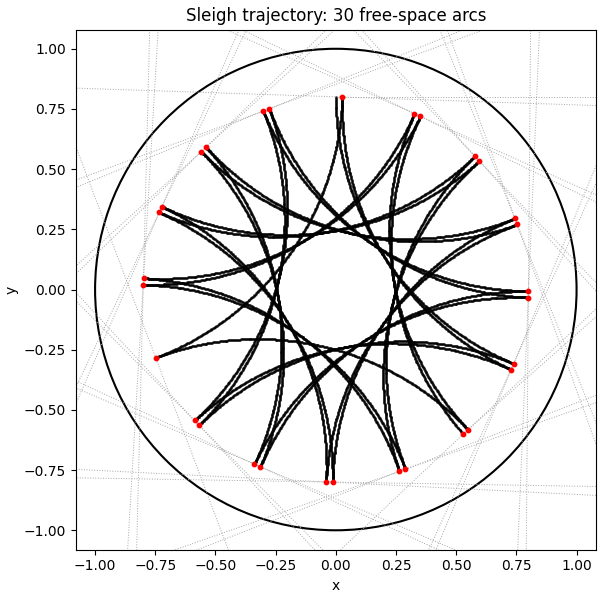
The integrability of balanced Chaplygin sleigh billiard in a diskClassical billiards form a rich area of research involving Hamiltonian dynamics, integrability, and the transition to chaos. In recent years, this theory has been extended by considering generalized billiard systems in which either the free motion or the reflection law is modified. In this talk, I will discuss ongoing joint work with Prof. A. Bloch on a nonholonomic billiard system given by a balanced Chaplygin sleigh moving in a disk.
The Chaplygin sleigh is a classical nonholonomic system consisting of a planar rigid body subject to a knife-edge constraint, which forbids lateral motion at a distinguished contact point. In the balanced case, the center of mass coincides with the knife edge. As a consequence, the generic free motion is a rotation with constant angular velocity, so the contact point traces a circle. This structure allows us to describe the billiard dynamics using classical formulas for the intersection points of two circles, which determine the impact points on the disk boundary. I will explain the construction of the corresponding impact map and present the integrability of this nonholonomic billiard system.
Ana Chávez Calíz, UNAM-Cuernavaca, Mexico
Outer contact billiardsOuter symplectic billiards are naturally defined in even-dimensional spaces. Is there an odd-dimensional analogue?
Motivated by the Arnold–Givental philosophy that contact geometry is to symplectic geometry as projective geometry is to affine geometry, we introduce outer contact billiards, a projective counterpart of this construction. Starting from a linear symplectic space $V$, we consider its projectivization $PV$, equipped with its natural contact structure. The correspondence is obtained by replacing the affine midpoint condition with its projective analogue, namely harmonic conjugation.
We discuss its basic properties and present explicit examples with integrable dynamics. We also describe its interaction with the ambient contact structure and characterize the hypersurfaces for which the harmonic and midpoint constructions coincide.
This is joint work with Connor Jackman.
Yakov Eliashberg, Stanford U, US
Convex contactomorphisms and their dynamicsGiven a $(2n-1)$-dimensional closed contact manifold, its contactomorphism is called convex if its mapping torus viewed as a hypersurface in a contact manifold of dimension $2n+1$ admits a transverse contact vector field.
If $n=1$ and the manifold is the circle, convex contactomorphisms are circle diffeomorphisms with rational rotation numbers and non-degenerate periodic points. For $n>1$ any contactomorphism can be $C^0$-approximated by a convex one, but in general $C^1$-approximation is impossible.
In the talk I will discuss the dynamical meaning of convexity of contactomorphism and the proofs of the above results. The talk is based on a joint work with J. Chaidez and D. Pancholi.
Michael Gekhtman, Notre Dame, US
Cluster structures via birational Poisson mapsBased on a joint works with M. Shapiro and A. Vainshtein and D. Voloshyn I will present an overview of recent results showing how birational Poisson maps intertwining Poisson-homogeneous structures on the same Lie group can be used to construct exotic cluster structures starting from “standard” ones.
Alexander Givental, UC Berkeley, USA
Indeterminism and classical mechanicsWe challenge the traditional deterministic view of the classical mechanical universe by combining dynamical chaos with the distinction between physical phenomena and their mathematical models, and quantify the resulting indeterminism in several quasi-realistic examples.
Andrei Gudkov, Roswell Park Comprehensive Cancer Center, Buffalo, NY, USA
Mortality: The Meaning of Life’s Countdown (a public lecture)All life on Earth descends from a single ancestral source, yet its descendants have diverged into astonishingly different forms. Despite billions of years of separation, every species still relies on the same biochemical language: information encoded in nucleic acids and translated into proteins through a universally preserved code.
One might expect such a shared system to produce similar evolutionary trajectories. Instead, life split into two radically different paths. Bacteria – masters of adaptation – remained unicellular and tend to “forget” their previous states when adjusting to new challenges, keeping their genomes compact, efficient, and tightly organized. Eukaryotes – the branch that includes animals, plants, fungi, and us – continued evolving toward multicellular bodies of increasing complexity, accompanied by dramatic genome expansion and the accumulation of vast amounts of seemingly absurd information.
Why did one branch follow “flat evolution,” while the other – “progressive evolution” – built complexity and ultimately produced organisms capable of thought, memory, and culture?
I will present a concept addressing this paradox, in which mortality – life's builtin countdown – is an essential, though not exclusive, driver of evolutionary complexity. This perspective offers insight into why complex life emerged, why it took the path it did, and what implications this model may hold beyond biology.
Yuhao Hu, Shanghai Jiao Tong U, China
Hyperbolic Monge–Ampère systems with flatness conditionsFor hyperbolic Monge–Ampère systems, Bryant–Griffiths–Grossman's approach to the equivalence problem yields two invariant tensors, $S_1$ and $S_2$, defined on the underlying $5$-manifold. These tensors take similar forms, except that one is symmetric and the other anti-symmetric. It is known that ‘$S_2=0$’ is equivalent to the Euler–Lagrange condition, and that ‘$S_1=S_2=0$’ characterizes the homogeneous wave equation up to contact transformation. In comparison, little was known for the ‘$S_1=0$’ case. By using Cartan's method of equivalence, our analysis for both the $S_1=0$ and $S_2=0$ cases reveals contrasting phenomena, including generality, existence of symmetric examples, and richness of sub-cases defined by flatness conditions on invariants. This talk will be a report on these findings.
Ivan Izmestiev, TU Wien, Austria
Smooth, discrete, and semidiscrete Voss surfacesVoss surfaces are those that carry a conjugate net of geodesics. Their Gauss images are Chebyshev nets on the sphere, they can be isometrically deformed so that the net remains conjugate, and they are closely related to surfaces of Gaussian curvature $-1$. Discrete Voss surfaces are made of planar quadrilaterals, and semidiscrete ones of developable strips. In both cases, the rich properties of smooth Voss surfaces are preserved.
The talk is based on a joint work with Matteo Raffaelli and Arvin Rasoulzadeh.
Connor Jackman, ITAM, Mexico City, Mexico
Collinear motions of three bodies in a three-sphereFor three point masses on a sphere subject to mutual attractions, we examine those motions for which the three bodies are at all times contained along some geodesic (great circle) of the sphere. Note that the geodesic containing the bodies is not required to be fixed. When the geodesic containing the three bodies sweeps out a three-sphere, we give a complete description of such motions. The corresponding question in the Euclidean case was solved by A. Wintner (1941).
Boris Khesin, Univ of Toronto, Canada
The interval VirasoroWe construct a nontrivial central extension of the Lie algebra of vector fields on an interval vanishing at the endpoints, together with the corresponding central extension of the group of diffeomorphisms fixing the endpoints. The corresponding cocycles have a special form out of many equivalent forms valid for the Lie algebra of vector fields on a circle.
This result is a byproduct of the study of homeomorphisms of the circle that are smooth diffeomorphisms away from a finite set of $n$ points. These “broken diffeomorphisms” do not form a Lie group, but instead naturally assemble into a Lie groupoid. We construct an explicit nontrivial $n$-dimensional central extension of this groupoid, which restricts to the classical Virasoro group when confined to smooth diffeomorphisms. The associated “broken Virasoro” algebroid is a nontrivial $n$-dimensional central extension of the Lie algebroid of vector fields on the circle that are smooth except at $n$ points. This construction generalizes the Virasoro algebra. We also describe the associated Lie algebroid and groupoid for a "moving interval", obtained by allowing the endpoints of an interval to vary. This is a joint work with Anton Izosimov and Howard Xiao.
Andreas Knauf, Erlangen–Nürnberg, Germany
Regularisation by Hamiltonian extensionThere has been a long tradition to regularise the two-body problem of celestial mechanics, in order to deal with (near) collision orbits. Here we present a method that works not only for any spatial dimension $d \in \mathbb{N}$, but also for a known discrete family of homogeneous potentials.
Specifically, we consider (negative) potentials of (negative) homogeneity $2(1-1/n)$ for any $n \in \mathbb{N}$. Then there exists a Hamiltonian system $(P,\omega, H)$ which is a real-analytic extension of the unregularised one and has a complete flow. It is unique for $d \ge 2$. (Nonlinearity 38 (2025))
Mark Levi, Penn State, US
Billiards in horns and adiabatic invariantsI will review some results on billiards with singularities such as cusps and horns and will make some observations on adiabatic invariants. This is based on joint work with Boris Hasselblatt and David Ostrander.
Ezequiel Maderna, CIMAT, Mexico
Busemann functions and Green bundles at positive energy levels of the $n$-body problemBesides allowing us to understand celestial mechanics, the $n$-body problem motivates the development of new mathematical objects. I am interested in the study of dynamics at positive energy levels, and particularly in the open (non-empty) set formed by motions exhibiting hyperbolic expansions both in the past and in the future. This open set admits two invariant Lagrangian foliations, whose transversality is related to the possibility of locally solving a scattering problem. We will show the transversality of these foliations on the homographic Lagrange orbits. Joint works with Andrea Venturelli (Avignon) and Renato Iturriaga (Guanajuato).
Vladmir Matveev, Jena, Germany
Bernhard Riemann 1861 revisited: existence of flat coordinates for an arbitrary bilinear formWe generalize the celebrated foundational results of Bernhard Riemann and Gaston Darboux: we give necessary and sufficient conditions for a bilinear form to be flat. More precisely, we give explicit necessary and sufficient conditions for a tensor field of type (0, 2), which is not necessarily symmetric or skew-symmetric and is possibly degenerate, to have constant entries in a local coordinate system.
Results are joint with S. Bandyopadhyay, B. Dacorogna, and M. Troyanov.
Nick Ovenhouse, U Dallas, US
Cluster structures for super friezesSuper frieze patterns were introduced and studied by Morier-Genoud, Ovsienko, and Tabachnikov, as a generalization of the classical Conway–Coxeter frieze patterns. Together with Musiker and Zhang, we studied super cluster algebra structures on the decorated super Teichmüller spaces, and showed that the set of all super cluster variables forms a super frieze pattern. Also, in current ongoing work with Michael Shapiro, we developed a super analog of quiver mutation which models these cluster structures.
Valentin Ovsienko, Reims, France
Quantizing numbersThis talk provides an overview of the rapidly developing theory of $q$-deformed real numbers. Each irrational number corresponds to a power series with integer coefficients in one variable (denoted by $q$, following a certain tradition), while each rational number corresponds to two rational functions in $q$ (“left” and “right” $q$-rationals). This quantization is determined by the action of the modular group $\mathrm{PSL}(2,\mathbb{Z})$, which plays the role of the symmetry group.
I will briefly explain some interesting properties of $q$-numbers and some very recent applications to the quantization of Markov and Pythagorean triples.
Ron Perline, Drexel, US
Periodic congruent reflections associated with planar curvesAn old paper of Keller introduced periodic reflected line congruences (PRLC) to construct approximate solutions to the eigenvalue problem for the Laplacian for planar domains. The construction of (PRLC) could be an interesting object of study in its own right (in fact, work of Sergei is already related to this). Mostly, the talk will be about examples.
Leonid Polterovich, Tel Aviv U, Israel
Geometry of symplectic maps and topological persistenceI will review how persistence modules and barcodes, originally developed in topological data analysis, arise in symplectic topology. I will focus on their applications to Hofer geometry on the group of Hamiltonian diffeomorphisms. All necessary preliminaries will be explained.
Joint work with Egor Shelukhin.
Hector Sanchez Morgado, UNAM, Mexico
Subriemannian LagrangiansWe present the extension of several results of weak KAM theory to Lagrangians that are defined only on the horizontal distribution of a subriemannian manifold.
Boris Shapiro, Stockholm U, Sweden
Around maximal growth distributionsRichard Schwartz, Brown U, US
Minimal vertex origami tori (online)An origami torus is a finite union of triangles in $\mathbb{R}^3$ which makes an embedded torus, such that the sum of the angles around each vertex is $2\pi$. In its intrinsic metric, an origami torus is isometric to a flat torus. These things have been known to exist since 1960. In my talk I will discuss my answer to the following question: What is the minimum number of vertices needed to make an origami torus? (Answer: 8). I will also discuss a number of other results which have emerged since I found an 8-vertex origami torus.
Amir Vig, Toronto, Canada
A Poisson summation formula for symplectic billiardsWe will establish a semiclassical trace formula for symplectic billiards and show that the singular support of the trace is contained in the “area spectrum.” We will also pose several inverse spectral problems and discuss potential connections to convex geometry and physics.
Guowei Yu, Nankai, China
Marchal's lemma for the restricted $(N+1)$-body problem and its applicationsSince the proof of the Figure-Eight solution by Chenciner and Montgomery, the direct method of calculus of variations have had a great success in the classical Newtonian $N$-body problem. First in periodic solutions and more recently in parabolic, hyperbolic and hyperbolic-parabolic solutions. The foundation of many of these results is Marchal's lemma, which guarantees fixed-end local minimizers are collision-free and hence classical solutions of the problem.
Meanwhile almost no result is available in the restricted problem through the direct methods of calculus of variations. Mainly due to the lack of a Marchal type lemma. In this talk, we will first explain how to obtain such a result for the restricted problem, then how it can be used to study periodic, hyperbolic and parabolic solutions in this case. This is joint work with Kuo-chang Chen.
Vadim Zharnitzki, Urbana-Champaign, US
Optimal damping in the mass-spring systemsIt is a well-known textbook example in classical mechanics that a single-degree-of-freedom mass-spring harmonic oscillator achieves its fastest exponential decay when the damping is critical. We study the analogous problem of designing optimal damping for a system of several coupled linear oscillators. Using the Weyl–Horn theorem, we construct an explicit damping matrix that theoretically realizes the best possible exponential decay rate of the system, which turns out to be the geometric mean of the natural frequencies. We show that this damping strategy outperforms the classical Rayleigh (proportional) damping approach. We also characterize the parameter regimes in which the optimal damping matrix necessarily ceases to be positive definite, and discuss the implications of this phenomenon.
This is a joint work with M. Arnold (UT-Dallas, USA) and O. Gendelman (Technion, Israel).
Michael Zhitomirskii, Technion, Israel
Local classification problems with functional moduliI will discuss the class of local classification problems, including classification of vector distributions, Riemannian metrics, conformal structures, real hypersurfaces in $\mathbb{C}^n$, where the functional dimension of the space of objects is bigger than that of the transformation group, unlike the classification problem of singularity theory where it is not so. I will explain that combining a coordinate-free approach with normal forms gives a nice explanation of known results and many new results.